The Design Secrets of the 2005 Nissan GT-R Proto That Still Define the R35 Today
Hero Introduction
The first time I really studied the photos from the 2005 Tokyo Motor Show, I was sitting in front of a low-resolution download at about two in the morning, and something stopped me cold. I’d been following GT-R development rumors for months — the whole community had, we were all starving for information — but this was different. Looking at the GT-R Proto on that stage, something clicked into place. Nissan wasn’t showing us a concept car. They were showing us a finished thought. An engineering statement wearing a body that happened to be one of the most purposeful, deliberately considered shapes I’d ever seen on a road car.
Most people at the time talked about the specs. 480 PS, twin-turbo V6, all-wheel drive, dual-clutch transaxle mounted at the rear. Those numbers were staggering. But what I couldn’t stop thinking about was the design. The shape. The way it sat. The way light played off those rear haunches. The quad headlights. The hood vents that looked like they were cut there by someone who actually understood aerodynamics rather than someone who thought they looked aggressive.
Here’s the thing nobody says enough: the GT-R Proto’s design wasn’t decoration wrapped around a performance brief. It was the performance brief, made physical. The team working under Shiro Nakamura — Nissan’s Global Design Director at the time — built something where aerodynamic, thermal, and mechanical requirements drove the aesthetic decisions. Not the other way around. Understanding that inversion is the key to understanding why the R35 still looks genuinely right in 2026.
Some of the Proto’s best details survived to production exactly as shown. Others were refined for real-world use. And a few — subtle in some cases, more significant in others — were evolved in ways worth understanding if you actually care about what you’re looking at.
For the full origin story of how the Proto came to exist, dig into the 2005 Nissan GT-R Proto: From Tokyo Motor Show Prototype to R35 Legend – The Ultimate Used GT-R Buying Guide. This article goes deeper on the design itself. The secrets the camera caught. The decisions that still define every R35 driven today.
Let’s look at this thing properly.
The Aggressive Stance That Changed Everything
Start with the width. Always start with the width.
The GT-R Proto measured approximately 1,895mm across. The R34 Skyline GT-R it was replacing — itself not a narrow car — measured 1,785mm. That’s 110 millimeters of additional presence, and in automotive design terms, that number is enormous. But what blew my mind, once I started really analyzing the proportions, is that raw width alone doesn’t tell the story. It’s how Nissan deployed that width that matters.
Most manufacturers, when they go wide, bolt on fender flares. It’s honest, it’s functional, and it reads visually as “we added width here.” The GT-R Proto — and the production R35 that followed — didn’t do that. The fender shoulders are pressed into the body structure itself. The haunch over the rear wheel is a continuous, flowing surface that originates from the door and becomes the rear fender in one unbroken movement. There’s no seam where “car” ends and “wide body” begins. One surface. One intent. One sweep from front to back.
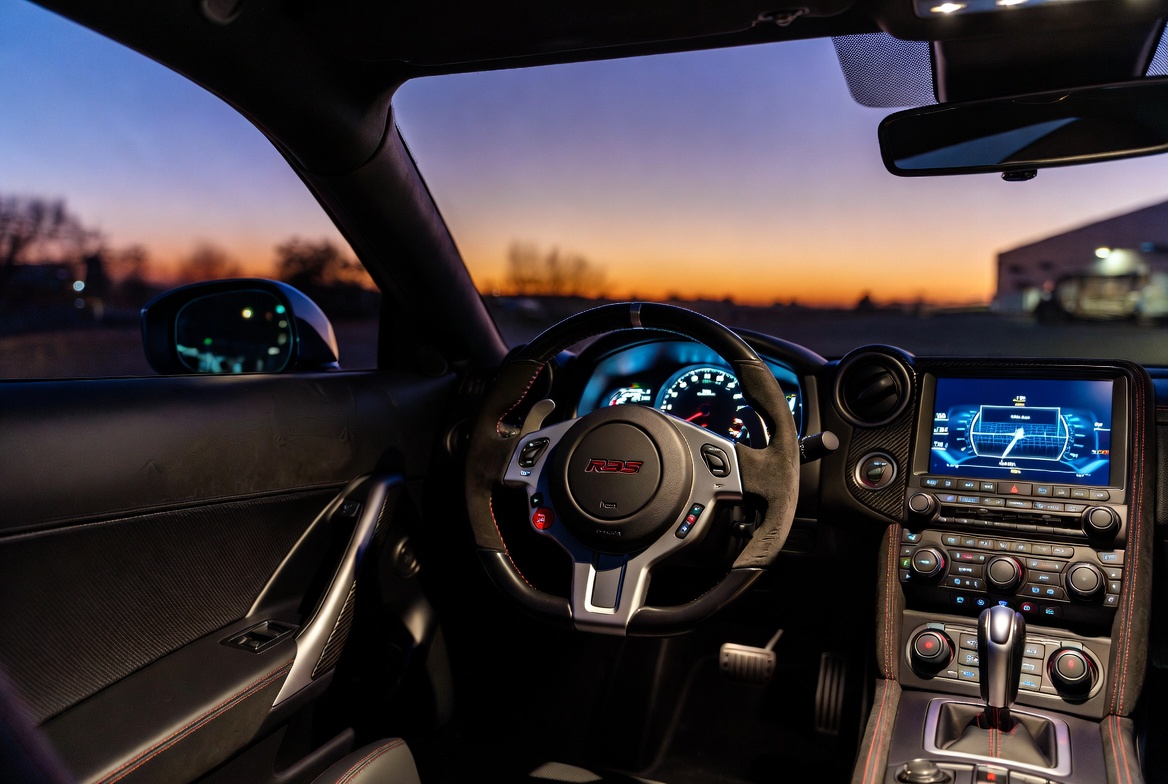
That decision came directly from the design brief Nakamura’s team worked under: visual authority without effort. No bolt-ons. No drama for its own sake. Every line had to earn its place.
The proportions are what get me when I study Proto photographs carefully. Long hood. Short rear overhang. Compact greenhouse — the roof deliberately low, the glasshouse deliberately tight and controlled. View it from above and you get the classic coke-bottle silhouette that defines the great GT cars, but pushed further than almost anything else from that era. The waist pinches decisively between wide front arches and those enormous rear haunches, and the visual tension it creates is genuinely magnetic.
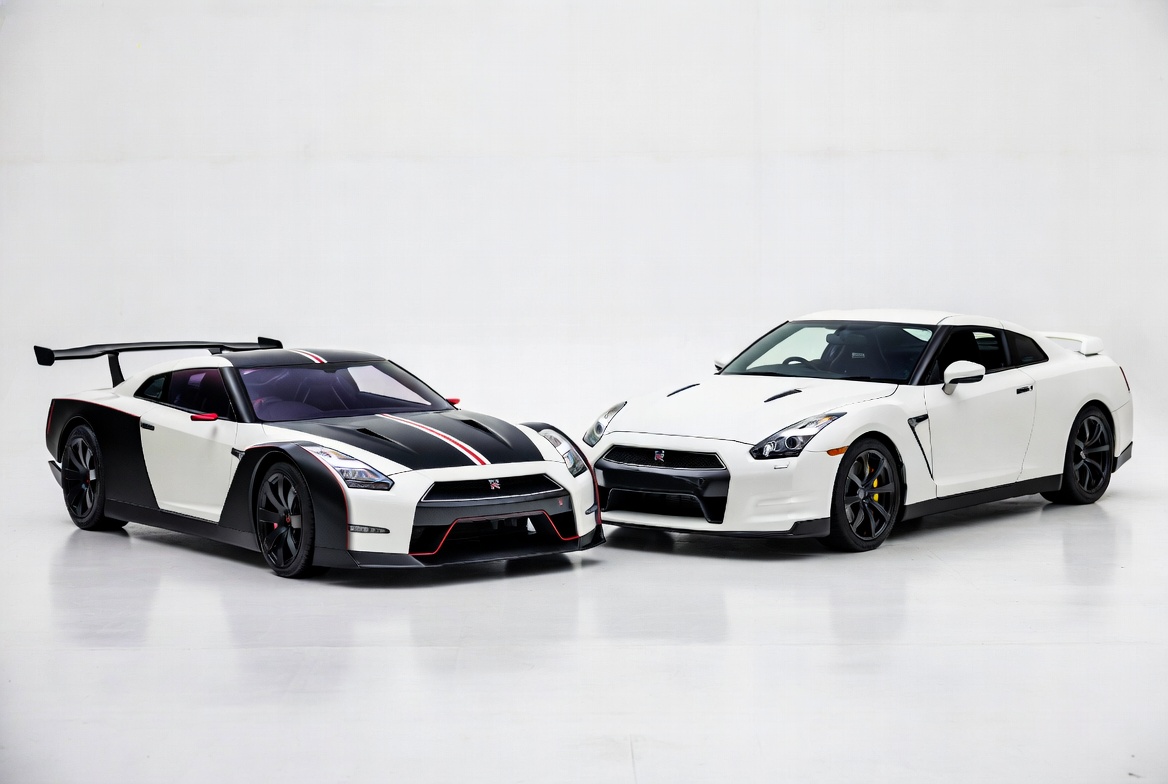
If you’ve ever stood next to an R35 in a car park and thought it still looks genuinely serious — not retro-serious, not nostalgia-serious, but now-serious — this is the geometric reason. These proportional decisions don’t age because they aren’t trends. They’re physics made visible. Nissan got the geometry correct with the Proto, and every R35 produced since has carried that geometry faithfully.
Aero Details Most People Miss
Let me tell you what I notice now that I didn’t notice the first hundred times I looked at Proto photographs. Not the big shapes. The small things. Because Nissan’s team hid a lot of serious functional thinking in places most people’s eyes slide straight past.
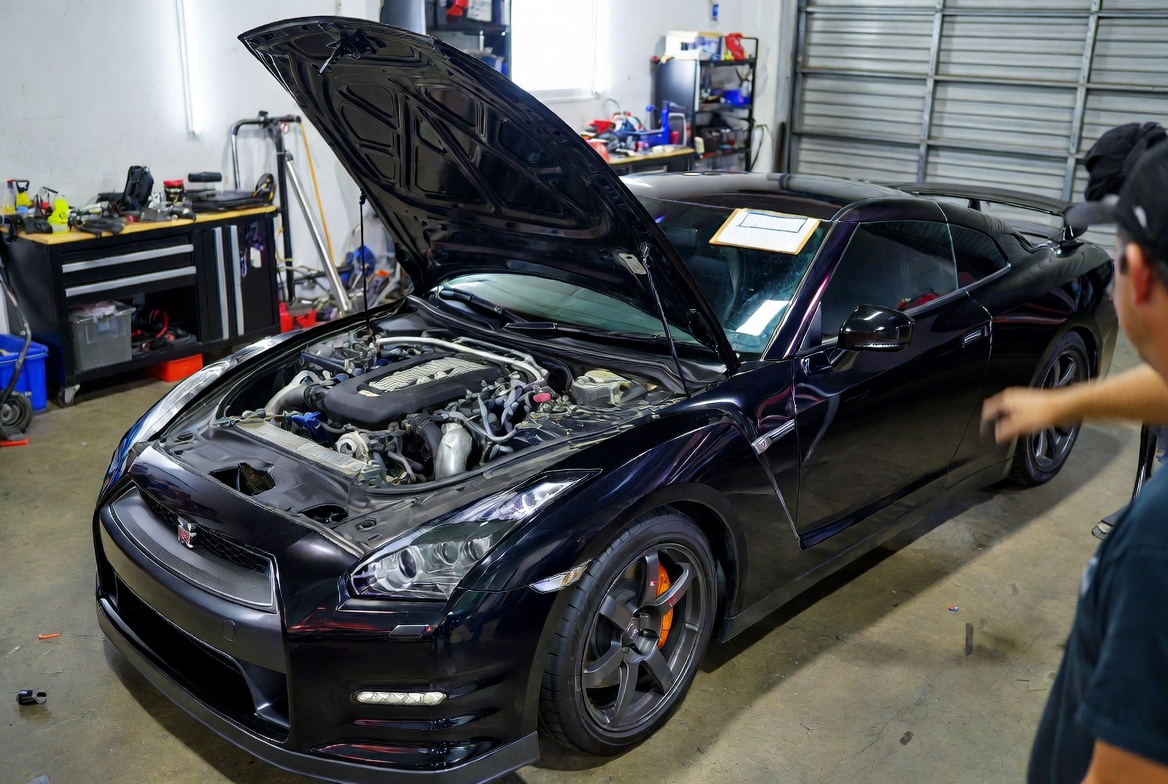
The hood vents. Everyone sees them. Very few people understand them properly. On the Proto, the twin extraction outlets sit further forward and run noticeably wider than on the production car. Why? Because at prototype stage, the engine bay thermal mapping wasn’t finalized. The vents were sized and positioned conservatively — better to extract too much hot air than too little during a development phase where you don’t yet know your worst-case heat concentrations. The production car’s vents are repositioned rearward and shaped more precisely because Nissan’s thermal engineers, by that point, had mapped exactly where the highest air temperatures lived at sustained high speed. Those relocated vents are not a styling revision. They are a solved thermal equation wearing a body panel.
The front bumper is three separate aerodynamic functions wearing one face. The center opening feeds the intercoolers. The lower outer inlets feed brake cooling ducts routed through the front subframe to the front calipers — those Brembo six-pots run serious heat and need constant airflow at track speeds. And the geometry of the entire lower bumper section generates measurable front-end downforce by directing incoming airflow beneath the car into the flat-floor channel running the length of the underbody. The Proto established all three of these functions simultaneously. The production car refined how efficiently each one operated.
The fender vents behind the front wheels exist to do one precise thing: extract turbulent, pressurized air from the front wheel wells. At speed, spinning wheels create enormous pressure inside the wheel arch. Unmanaged, that pressure creates lift at the front axle and increases drag at the same time — the worst possible aerodynamic double penalty. The Proto’s vents addressed this with a dramatically sculpted, deeply recessed surround. Production vents are flatter and more flush — which actually allows them to work more efficiently by reducing the pressure differential at the exit point.
The rear diffuser deserves its own article. The Proto’s diffuser is prominent, aggressive, and deeply channeled — twin tunnels accelerating air away from the flat floor to reduce pressure beneath the car, which is how you generate real rear downforce without a monstrous fixed wing creating drag. The center section on the Proto was less resolved than it ultimately became in production — the twin exhaust integration sat slightly less cleanly in the surrounding diffuser geometry. But the underlying philosophy established there is exactly what you see on every production R35, wind-tunnel refined and genuinely functional at triple-digit speeds. None of it is visual theater. All of it is working.
Lighting and Signature Elements
This is what I want to talk about when people ask me why the R35 still feels connected to something larger than itself. Most modern performance cars feel like they were designed from scratch, in a vacuum, with no acknowledgment of lineage. The R35 doesn’t feel that way. It carries memory. And that memory lives most visibly in the lights.
The stacked quad-lamp headlight arrangement on the Proto was not an arbitrary styling decision. It was mandatory. Non-negotiable. Beginning with the R32 Skyline GT-R in 1989, the “double round” arrangement — two circular lamps stacked vertically on each side — has been the defining visual signature of the GT-R bloodline. The R33 carried it. The R34 refined it. When Nissan began designing the R35 Proto, the quad-lamp arrangement wasn’t a proposal on a mood board. It was a condition of the brief. You could not call it a GT-R if those lights weren’t there. Shiro Nakamura’s team understood that some design elements aren’t choices — they’re inheritance.
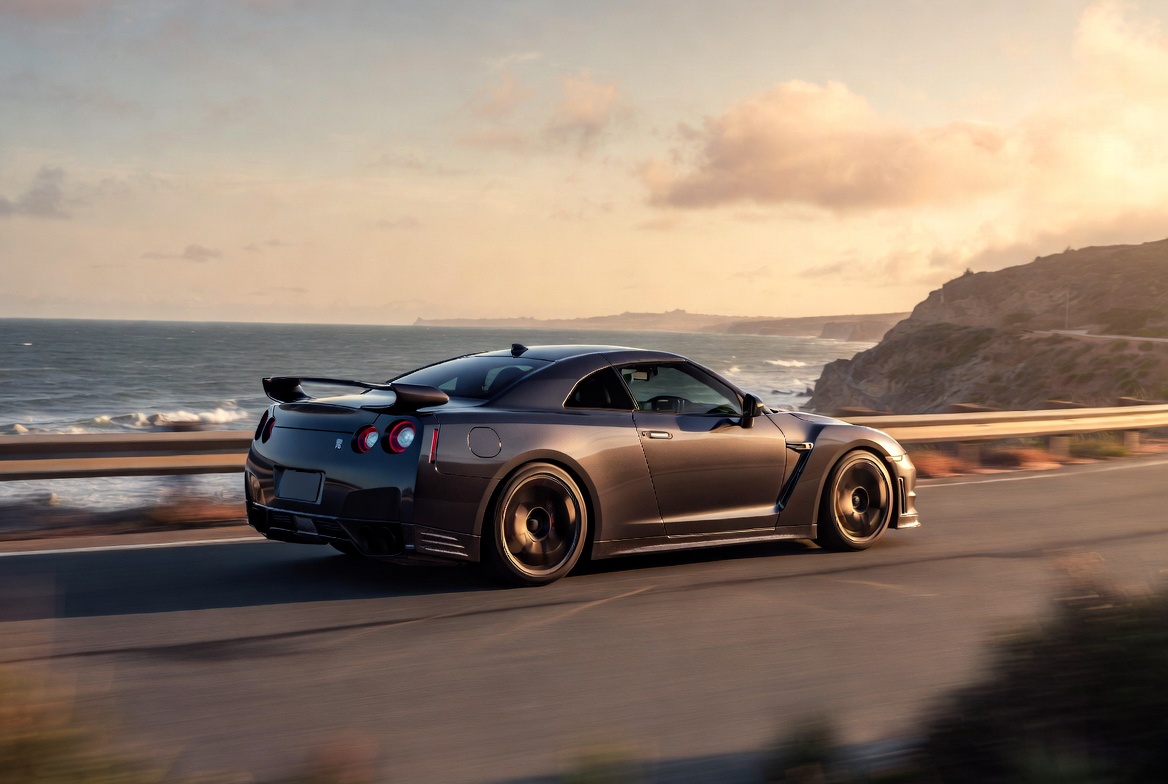
But what I find genuinely fascinating — and it took real study of Proto photographs before I registered it — is how the Proto’s headlight execution differs from the production car in ways that are subtle but meaningful once you see them. The Proto’s lamp shrouds have harder, more angular geometry at the inner edges. The lens treatment is sharper. There’s a more aggressive cutline between the upper and lower lamp units. It makes the Proto’s front end read as almost confrontational in a way the production car softened to serious. The difference is not large. But the Proto’s face has something in it that production refined away — an edge, a sharpness that you feel before you consciously register it.
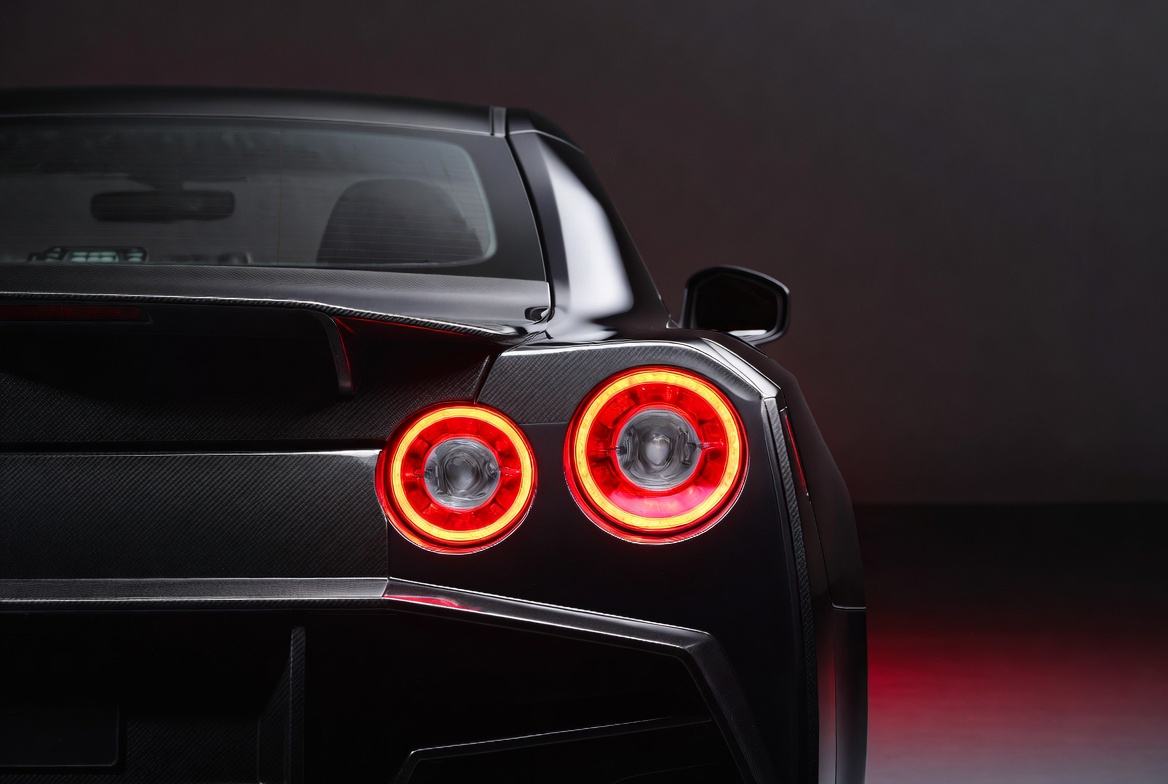
What blew my mind was realizing the taillight story runs in the opposite direction. The Proto’s rear lamp units were rounder — almost circular — clearly echoing the front arrangement and creating a front-to-rear symmetry that felt mathematically intentional. Four round lamps up front, four round lamps at the back. Perfect bilateral symmetry in the car’s light signature.

The production car moved toward a thicker, more horizontal taillight graphic. Still quad in arrangement. Still unmistakably in the family. But the perfect circular symmetry of the Proto — that pure, intentional echo between front and rear — was softened. My understanding of this decision is a combination of factors: production taillights needed to be larger for global type-approval visibility requirements, and the horizontal graphic reads more legibly at distance in following traffic. The engineering reasons are sound. And the production taillights have become iconic entirely on their own terms.
But I still think about the Proto’s round rears when I stand behind an R35 at night.
The details that complete the picture: parallel hood crease lines running the full nose length, creating a visual power channel that draws your eye toward the engine beneath. The inward taper of the rear bumper at center, directing attention down toward the diffuser. The tight C-pillar angle that makes the roofline feel purposeful rather than comfortable. None of these are in any press release. You find them by staring at photographs long enough. They separate a car designed by people who cared obsessively from a car shaped by a committee.
What Got Changed (and Why It Still Matters)
Being honest about the refinements from Proto to production makes the design more interesting, not less.
We covered the technical dimension of these changes in Nissan GT-R Proto vs Production R35: Key Differences That Shaped the Legend. From a pure design perspective, the most significant evolutions were the hood vent repositioning, the headlight surround geometry, the taillight graphic, and the fender vent integration depth. And every single one was driven by real requirements — thermal engineering, regulatory compliance across multiple global markets, aerodynamic efficiency testing, and long-term manufacturing precision. Not aesthetic preference. Not cost reduction. Real engineering completing a design intent.
That context matters enormously. The changes from Proto to production R35 are not a design vision being compromised by business reality. They’re a design vision being completed by engineering reality. The Proto was a promise with some seams still showing. The production car honored that promise by resolving every seam.
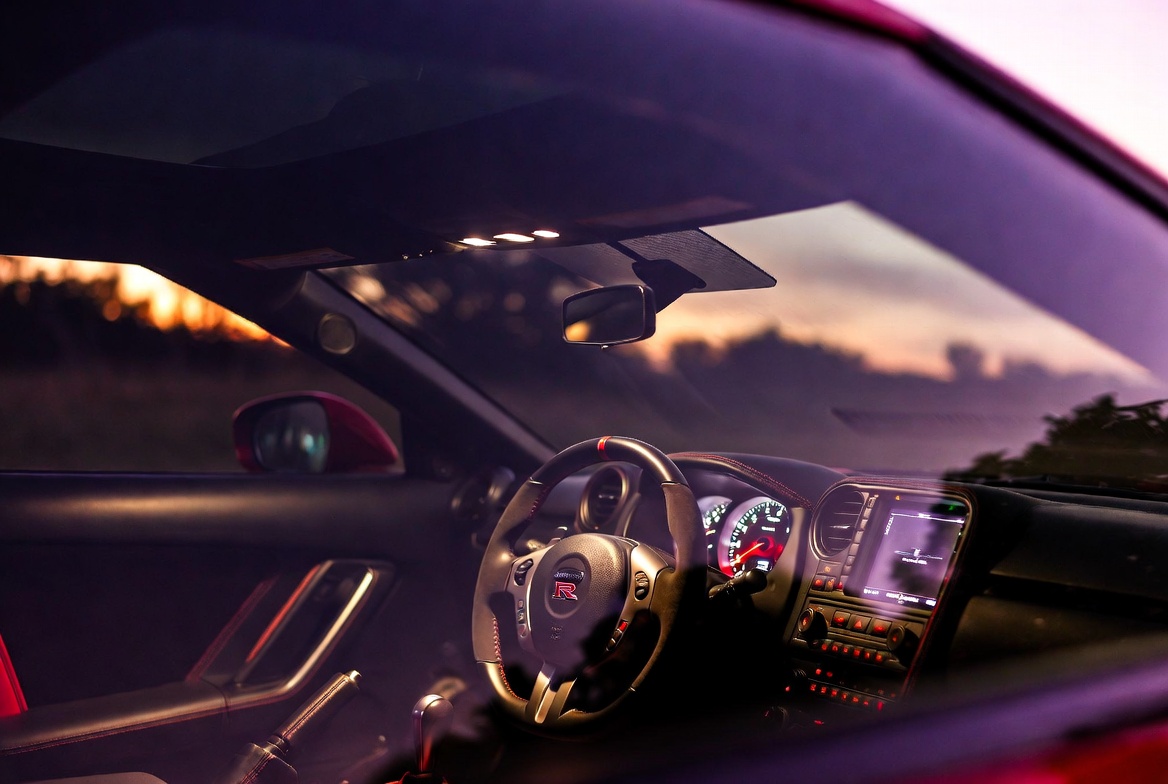
If I’m being fully honest, the one thing that still makes me wistful is that taillight symmetry. The Proto’s circular rear lamps, perfectly echoing the quad fronts, was a piece of visual storytelling that I find genuinely beautiful. I understand exactly why production moved away from it. I understand the visibility regulations, the market requirements, the legibility argument. I understand all of it completely.
And then I stand behind a production R35 at night, watching those thick red arcs come to life, and my nostalgia evaporates. They’re right. Not what the Proto promised, but right in their own language. That’s what good design evolution looks like — not copying the prototype, but honoring its spirit in a form that works better for the life the car actually has to live.
Final Thoughts
Twenty years on from Tokyo 2005, I still find new things in GT-R Proto photographs. A surface transition I’d looked past a dozen times. A proportion relationship I hadn’t consciously measured. A detail that suddenly explains something about the production car I’d always taken for granted. This is the mark of genuinely layered design — it rewards continued attention. It doesn’t hand you everything at once.
The R35 carries so much of the Proto’s design language that studying the show car is essentially studying the production car’s DNA. Every proportion decision, every aero philosophy, every heritage lighting cue — it flows forward from that October 2005 stage directly into every R35 ever sold.
If you’re already in the ownership world — or getting there, check out Is a Used R35 GT-R Worth Buying in 2026? The Proto Bloodline Advantage for the practical side — knowing that your car’s shape carries this specific design intent gives you a different relationship with it. You’re not just driving a fast car. You’re driving a considered philosophy made physical. Every vent is solving a problem. Every surface is earning its existence. Every light is remembering something.
The GT-R Proto didn’t just preview the R35. It justified it.
That’s the real secret. And it’s been sitting in those Tokyo photographs all along.
FAQ
Q: Who led the exterior design of the GT-R Proto at Nissan?
The GT-R Proto’s exterior was developed under Shiro Nakamura, Nissan’s Global Design Director at the time, with his team working closely alongside chief vehicle engineer Kazutoshi Mizuno. The collaboration between design and engineering was unusually tight for the era — which is precisely why the Proto’s surfaces look like they’re solving real problems rather than just looking dramatic. The design brief and the engineering brief were essentially the same document.
Q: Why did the Proto have rounder taillights than the production R35?
The Proto’s circular rear lamp units were designed to create pure front-to-rear symmetry with the quad headlights — four round lamps at the front, four at the rear. For production, Nissan moved to a thicker, more horizontal lamp graphic, primarily to meet global type-approval visibility requirements and to improve legibility at distance for following traffic. The production lights became iconic in their own right, but the Proto’s symmetrical philosophy was a beautiful design idea that didn’t fully survive the engineering process.
Q: Are the GT-R Proto’s hood vents purely aesthetic or genuinely functional?
Genuinely functional, though in a different way than the production car’s vents. The Proto’s vents were sized and positioned for worst-case prototype thermal management — larger and further forward than ultimately necessary. The production car’s vents were repositioned based on finalized engine bay heat mapping, making them more precisely functional. Both versions are doing real work. The Proto version was conservative engineering. The production version was optimized engineering.
Q: What is the single most distinctive design element that connects the Proto to every previous Skyline GT-R?
The stacked quad headlights, without question. The “double round” lamp arrangement — two circular units stacked vertically on each side — has appeared on every GT-R from the R32 in 1989 through the Proto in 2005 and the production R35 today. It was not a design option during the R35 Proto’s development; it was a condition of the project. The GT-R could not wear any other headlight arrangement and still carry the name honestly. It’s the most durable design inheritance in the car’s fifty-year history.